- London Experiences
- London-on-Sea
- Outside the M25
- Food & Drink Gifts
- Gifts for Couples
- Gifts for Him
- Gifts for Her
- Birthday Gifts

Most people think The City is all suits, spreadsheets and people called Nigel discussing interest rates.
And yes, there are plenty of those.
But underneath the glass towers is the oldest part of London. Roman walls still stand here. Medieval alleyways disappear between skyscrapers. Ancient churches sit in the shadows of buildings that look like they've landed from the future.
The City isn't London's financial district.
It's London's origin story.
Come on a weekday and you'll find the streets buzzing with workers, lunch spots and after-work drinkers. Visit at the weekend and it feels like you've somehow stumbled into a secret version of London that most people never see.
Because this was London.
Long before Greater London existed, before Camden, Shoreditch or Notting Hill became places people talked about, there was simply the City of London.
Founded by the Romans nearly 2,000 years ago, the City remains its own strange little world, complete with its own Lord Mayor, traditions and governance that pre-date Parliament.
It's only one square mile in size, but almost everything London became started here.

The Romans called it Londinium.
They built roads, walls, markets and ports here, creating the foundations of a city that would eventually become one of the most influential places on earth.
The Great Fire of London swept through these streets in 1666. Christopher Wren rebuilt much of what was lost. Traders, merchants, bankers and adventurers all left their mark.
The result is a part of London where every street seems to belong to a different century.
You don't really visit The City.
You wander through it and accidentally discover things.


Unlike Shoreditch, where everyone looks like they're on their way to a gallery opening, or Camden where everyone looks like they're in a band, The City is full of contrasts.
At lunchtime you'll see traders, lawyers, architects, tourists, historians and curious wanderers all sharing the same streets.
It's one of the few places in London where a Roman ruin, a medieval church and a skyscraper can all be part of the same view.
Come here if you like…


One of London's defining landmarks. Climb to the Whispering Gallery and you'll see the city unfold beneath you.
A Victorian market so beautiful it feels like a film set. (It actually was one.)
The building that proved office blocks didn't have to be boring.
Built to commemorate the Great Fire of London. Climb the stairs and earn the view.
Part cultural centre, part concrete labyrinth, part architectural love-it-or-hate-it masterpiece.

A peaceful green space famous for the Memorial to Heroic Self-Sacrifice.

A ruined church transformed into one of London's most beautiful hidden gardens.

One of London's oldest civic buildings, complete with a Roman amphitheatre beneath it.

The historic heart of London's financial district where old and new London meet.
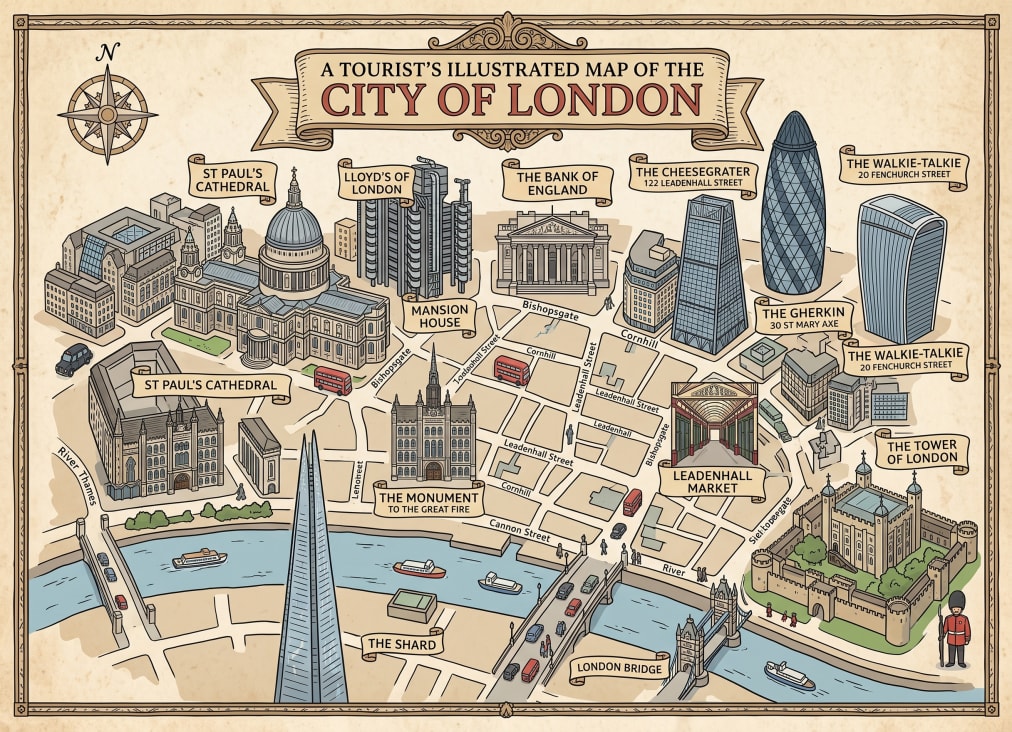
Even if you have no interest in finance, The City is one of London's richest areas for history, architecture and hidden discoveries. Think less "business district" and more "2,000 years of London compressed into one square mile."
It's the oldest part of London and one of the world's most important financial centres. But it's equally famous for landmarks such as St Paul's Cathedral, Leadenhall Market, the Great Fire of London and its remarkable concentration of history.
Very. The City specialises in hidden corners, atmospheric pubs, rooftop views and quiet streets that feel surprisingly romantic once the office workers have gone home.
Visit a ruined church garden, find Roman walls, explore secret alleyways, discover London's smallest statue or spend an afternoon hunting down historic pubs that have survived for centuries. The City rewards curiosity.
You can see the highlights in a day. But The City is one of those places that reveals itself slowly. Every visit uncovers another alleyway, another church, another hidden story.
During the week it's energetic, ambitious and fast-moving. At weekends it becomes something completely different: quiet, atmospheric and surprisingly beautiful. It's London stripped back to its foundations.